Saturday, June 20, 2009

The Meaning and Beauty of Angel Tattoos


When deciding what kind of tattoo to put on your body, it's important to remember that the symbol will remain for the rest of your life. Choose something that is beautiful, represents what you believe in, and is a design you won't be ashamed for the world to see when you're in a bathing suit. An angel tattoo fits all of these characteristics, so it isn't surprising that these are some of the most popular tattoos out there. On a typical day at the beach, it's not uncommon to see a substantial number of people with some kind of angel tattoo prominently displayed.

Traditionally, angels were entirely a religious symbol. In the stories of the bible, these heavenly creatures were sent down by God to transmit messages to mere mortals on Earth. Their actions and words could be both positive and negative-they were capable of good and bad.

Some of the millions of people who sport angel tattoos today reflect something of that original biblical sentiment, but many others simply like the design. Angels have come to represent something separate from religion. As a symbol, the angel is an overwhelmingly positive life force, and many people are excited to display this measure of happiness in the form of a tattoo somewhere on the body.

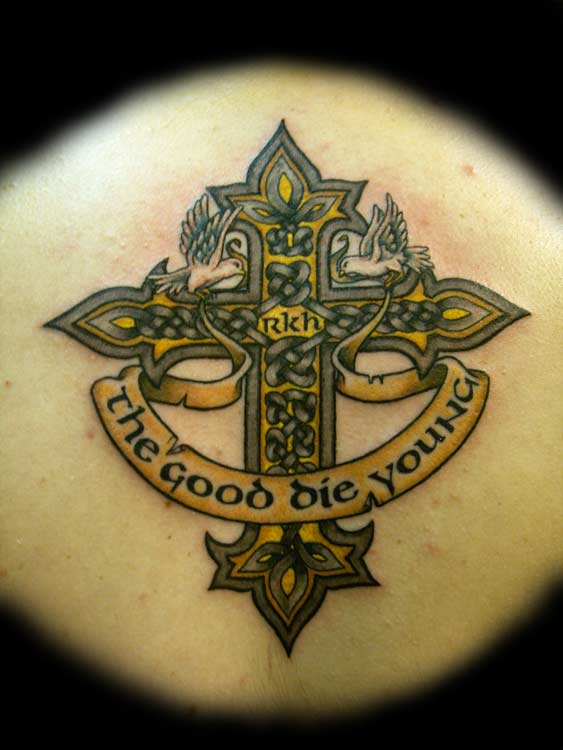
Many people also get angel tattoos placed on their body to commemorate the loss of a loved one. These tattoos are sometimes accompanied by "R.I.P.", short for rest in peace. It's also commonplace to see initials somewhere in the vicinity of the angel tattoo. The symbolism of this kind of angel tattoo is that the loved one is looking down from heaven, protecting those he cares about from above. With all of the uncertainty in the world, who couldn't use a guardian angel?

The majority of angel tattoos appear on female's bodies. There's something inherently sexy about the angel. Perhaps it's the possibility of sin; after all, Satan was nothing more than a fallen angel. Angels, therefore, represent the possibilities of straying to the dark side.

Today, there are a large number of different forms and styles of angel tattoos. In fact, there really is no limit to what an angel tattoo can look like. While some take the definite form of an old-school seraph from the bible, others are much more abstract. The typical "traditional" angel is beautifully suffused in light, wearing a white robe, and floating majestically on top of a cloud.

Another popular version of this tattoo is the "angel tattoo wings", splayed across the entire back of the subject. These seem to flex like wings when the shoulder muscles are contracted. This way, you can really bring your tattoo to life.

It's up to you to decide which style best suits your personality and taste. Angels represent quite a broad spectrum, and you can use them to express an enormous breadth of opinions and sentiments. Whichever design you decide on, you'll enjoy the benefits of having a sexy, strong symbol adorning your body.

The Meaning and Beauty of Angel Tattoos


When deciding what kind of tattoo to put on your body, it's important to remember that the symbol will remain for the rest of your life. Choose something that is beautiful, represents what you believe in, and is a design you won't be ashamed for the world to see when you're in a bathing suit. An angel tattoo fits all of these characteristics, so it isn't surprising that these are some of the most popular tattoos out there. On a typical day at the beach, it's not uncommon to see a substantial number of people with some kind of angel tattoo prominently displayed.

Traditionally, angels were entirely a religious symbol. In the stories of the bible, these heavenly creatures were sent down by God to transmit messages to mere mortals on Earth. Their actions and words could be both positive and negative-they were capable of good and bad.

Some of the millions of people who sport angel tattoos today reflect something of that original biblical sentiment, but many others simply like the design. Angels have come to represent something separate from religion. As a symbol, the angel is an overwhelmingly positive life force, and many people are excited to display this measure of happiness in the form of a tattoo somewhere on the body.

Many people also get angel tattoos placed on their body to commemorate the loss of a loved one. These tattoos are sometimes accompanied by "R.I.P.", short for rest in peace. It's also commonplace to see initials somewhere in the vicinity of the angel tattoo. The symbolism of this kind of angel tattoo is that the loved one is looking down from heaven, protecting those he cares about from above. With all of the uncertainty in the world, who couldn't use a guardian angel?

The majority of angel tattoos appear on female's bodies. There's something inherently sexy about the angel. Perhaps it's the possibility of sin; after all, Satan was nothing more than a fallen angel. Angels, therefore, represent the possibilities of straying to the dark side.

Today, there are a large number of different forms and styles of angel tattoos. In fact, there really is no limit to what an angel tattoo can look like. While some take the definite form of an old-school seraph from the bible, others are much more abstract. The typical "traditional" angel is beautifully suffused in light, wearing a white robe, and floating majestically on top of a cloud.

Another popular version of this tattoo is the "angel tattoo wings", splayed across the entire back of the subject. These seem to flex like wings when the shoulder muscles are contracted. This way, you can really bring your tattoo to life.

It's up to you to decide which style best suits your personality and taste. Angels represent quite a broad spectrum, and you can use them to express an enormous breadth of opinions and sentiments. Whichever design you decide on, you'll enjoy the benefits of having a sexy, strong symbol adorning your body.

Celtic Design Tattoos


Celtic design tattoos have experienced a massive revival in recent years. The history of the Celts goes back thousands of years. The early Celtic people displayed their skills in complex artwork and were regarded as fierce warriors by the Romans. Influences for Celtic design tattoos and evidence of Celtic crosses and Celtic artwork can still be found all over Ireland.

Modern Celtic people have evolved symbols for themselves, and North Americans, of Celtic descent often adorn Celtic design tattoos to show off their Celtic origin. The ancient Celts passed knowledge down through an oral tradition of storytelling and didn't keep many written records. Consequently, there is little evidence of their actual Celtic design tattoo preferences remaining even though Cross Celtic design tattoos and Knot Celtic design tattoos are very popular designs.

Most of Celtic design tattoos are taken from the Irish Illuminated Manuscripts The Book of Kells, which is on display in the library of Trinity College in Dublin. This manuscript represents a much later time period than the time period of the height of Celtic design tattoo. Designs from ancient stone and metal work are more likely to be from the same time period as Celtic design tattooing.

Knot Celtic design tattoos are usually loops with no end or beginning, much like the Mobius strip, symbolizing the never ending cycle of death and rebirth. Celtic animal (zoomorphic tattoo designs) designs are similar in construction but the cords traditionally terminate in the feet, heads or tails of the Celtic design tattoos. Pure knots are usually unending, unless the end of a strand is stylized into a zoomorphic element or a spiral.

The intricacy of Knot Celtic design tattoos, defy literal translation and their meaning are to be found at a deeper level. The repeated crossing of the physical and the spiritual are expressed in the interlacing of the knots. The never ending path of the strands may represent the permanence and the continuum of life, love and faith. For these reason Celtic design tattoos have become incredibly popular.

If you are of Celtic heritage, whether Irish, Scots or Welsh, getting Celtic design tattoos is a way of expressing pride in your heritage by reaffirming an affinity to the indigenous artistic style of your ancestors. Celtic design tattoos are not easy designs to recreate, and it is strongly recommended to make sure that your artist has experience in designing Celtic design tattoos. Not all tattoo artists have such an eye for detail and exacting line placement required for the intricate patterns particular to Celtic design tattoos.

Celtic Design Tattoos


Celtic design tattoos have experienced a massive revival in recent years. The history of the Celts goes back thousands of years. The early Celtic people displayed their skills in complex artwork and were regarded as fierce warriors by the Romans. Influences for Celtic design tattoos and evidence of Celtic crosses and Celtic artwork can still be found all over Ireland.

Modern Celtic people have evolved symbols for themselves, and North Americans, of Celtic descent often adorn Celtic design tattoos to show off their Celtic origin. The ancient Celts passed knowledge down through an oral tradition of storytelling and didn't keep many written records. Consequently, there is little evidence of their actual Celtic design tattoo preferences remaining even though Cross Celtic design tattoos and Knot Celtic design tattoos are very popular designs.

Most of Celtic design tattoos are taken from the Irish Illuminated Manuscripts The Book of Kells, which is on display in the library of Trinity College in Dublin. This manuscript represents a much later time period than the time period of the height of Celtic design tattoo. Designs from ancient stone and metal work are more likely to be from the same time period as Celtic design tattooing.

Knot Celtic design tattoos are usually loops with no end or beginning, much like the Mobius strip, symbolizing the never ending cycle of death and rebirth. Celtic animal (zoomorphic tattoo designs) designs are similar in construction but the cords traditionally terminate in the feet, heads or tails of the Celtic design tattoos. Pure knots are usually unending, unless the end of a strand is stylized into a zoomorphic element or a spiral.

The intricacy of Knot Celtic design tattoos, defy literal translation and their meaning are to be found at a deeper level. The repeated crossing of the physical and the spiritual are expressed in the interlacing of the knots. The never ending path of the strands may represent the permanence and the continuum of life, love and faith. For these reason Celtic design tattoos have become incredibly popular.

If you are of Celtic heritage, whether Irish, Scots or Welsh, getting Celtic design tattoos is a way of expressing pride in your heritage by reaffirming an affinity to the indigenous artistic style of your ancestors. Celtic design tattoos are not easy designs to recreate, and it is strongly recommended to make sure that your artist has experience in designing Celtic design tattoos. Not all tattoo artists have such an eye for detail and exacting line placement required for the intricate patterns particular to Celtic design tattoos.

Thursday, June 11, 2009

About Tattoo

Tattoo comes from the Tahitian word, it's that many people thought that the tattoo came from different countries are like that but on the development of the tattoo in the world this is not a rapid one as some people think that, then one of the countries interested in the tattoo start from small children to adults, let alone many tattoo creations and is vary for we have on the body kita.kalau we begin to see the development over time of such development of the tattoo also, dikota cities large and small a lot of tattoo lovers who willingly spent money to get their tattoo is very interesting and good, because of their tattoo is the symbol of masculinity and the trend of young people of today so if you do not have any tattoo carefully you will be spelled out or old-fashioned behind zaman.dan let's tattoo collection I see the following ..


By : Rofi

About Tattoo

Tattoo comes from the Tahitian word, it's that many people thought that the tattoo came from different countries are like that but on the development of the tattoo in the world this is not a rapid one as some people think that, then one of the countries interested in the tattoo start from small children to adults, let alone many tattoo creations and is vary for we have on the body kita.kalau we begin to see the development over time of such development of the tattoo also, dikota cities large and small a lot of tattoo lovers who willingly spent money to get their tattoo is very interesting and good, because of their tattoo is the symbol of masculinity and the trend of young people of today so if you do not have any tattoo carefully you will be spelled out or old-fashioned behind zaman.dan let's tattoo collection I see the following ..


By : Rofi

Saturday, February 14, 2009

The Temporary Tattoos


A number of people when traveling around Indonesia and particularly Bali, enjoy the exotic creations of temporary tattoo artists. They are on every main street in the holiday hotspots and are also found at school fairs and other festivities in and around the cities.

The main ingredient used for these temporary tattoos and/or Mehndi (the traditional art of henna painting in India and the Middle East) is henna. Pure, natural henna gives a chocolate brown or deep mahogany red stain on the hands and feet. On other parts of the body the stain can be tea-coloured; the shades can vary depending on the individual and other factors such as skin colour. Henna's dye component, hennotannic acid, does not pass through into the dermis (living cells) layer of the skin, it only stains the dead cells in the epidermis. Hennotannic acid naturally makes the brick/red/brown stains and it usually takes many hours to get a good henna stain on the skin, and is relatively safe. Allergic and irritant reactions are very rare. To make the dye, henna leaves are dried and finely ground and the powder is filtered; the artist then mixes the fine powder with an oil (such as eucalyptus oil) and other liquids (lemon, water, or tea), making a thick paste. This may sometimes appear to be black when wet and freshly applied to the skin, but on closer inspection is unlikely to be so.

Henna, however, is not black and most "black henna" as it is called is natural henna adulterated with a toxic chemical dye to make it black and to speed up the dyeing process. There are more and more people who are having problems of skin reactions with so called "black henna" within Indonesia. The fact of the matter is that it is not the henna that is the problem but the toxic dye called para-phenylenediamine or PPD for short, that people are adding to the henna to produce the black stain on the skin. PPD may also be used on its own to stain skin black and it stains the skin absolutely black within 2 hours and the stain can last easily 2 weeks. PPD penetrates deep into the skin, reaching the dermis and passing into the blood stream and can be dangerous to your system and not only affect the skin where it has been applied.

While there are a few safe products out there, most "black henna" contains PPD, and is found in many black hair dyes; there are some black (and other coloured) henna stains that claim not to contain PPD but rather use other non-toxic colourants; individuals would need to check on the actual ingredients to determine this and the safety thereof.

The skin reactions to PPD "black henna" frequently resemble the photograph that has kindly been provided by a friend. P-Phenylenediamine can also cause delayed type hypersensitivity reactions on the skin exactly where the PPD "black henna" temporary tattoo was applied. Sometimes the reaction is mild, with a raised, itchy area where the "black henna" pattern was. More severe reactions include pustules, blisters, oozing sores, intense itching, and these often leave long-term scars on people. The onset of the reaction generally begins 1 day to 3 weeks after the PPD "black henna" has been applied. Sometimes the blisters come up while the black pattern is still visible, and other times the blisters appear when the pattern has faded. If someone has a hypersensitivity reaction one time to PPD "black henna", it will be more severe with each subsequent exposure.

It is of no use to "patch test" PPD "black henna" to see if you're going to have oozing Black Henna reactionsores and blisters, because the reaction can occur up to 6 weeks after exposure. Also, skin hypersensitivity reactions will be increasingly likely with each exposure to PPD. A person may have one PPD "black henna" tattoo with no reaction, but may have a severe reaction with the next PPD "black henna" tattoo. Even if there is no skin reaction to PPD, it is still a transdermal toxin and can be harming your internal organs without showing lesions on your skin!

Although rare, severe cases of immediate type hypersensitivity to PPD have been described in which the patients developed severe edema (swelling), irritation of the eyes and face and also difficulty in breathing.

PPD scarring may be permanent and post-inflammatory hypopigmentation may remain at the tattoo site (this means after the scarring and blistering has subsided, a long-lasting white ghost image of the tattoo remains).

If we cannot control the use of these toxic chemicals, there are ways to protect yourself from black henna and find responsible, traditional henna artists.

Unfortunately, it is usually our children who are the ones that wish to have the tattoos, but are also the ones who are particularly at risk.

How to recognise PPD-based "black henna":

  • If the paste is greenish, and smells like spinach or a hay bale, it is probably natural henna. Sometimes reputable henna artists add natural oils or herbs that can spice up the fragrance and darken the color.
  • If the paste is deep black or grayish, it is probably NOT natural henna and should be avoided. PPD paste is jet black.
  • Ask how long it takes to stain and how long it lasts. If the answers are "just an hour or two" and "a week or more", it's PPD. If the henna artist tells you that you only need to leave the paste on for an hour or two, their henna probably contains PPD and should be avoided! Real traditional henna must stay on your skin longer to make a stain - usually 6-12 hours. The resulting color will be a reddish brown, not black.
  • Ask how long it lasts. If the answer is "a week or more" then it most likely contains PPD.
  • Ask what colour it will give. If the answer is "pure black", it's PPD. Real henna does NOT stain black. PPD does stain black! If the artist is offering "colored henna" ask to see a list of ingredients, and decide for yourself if the product is safe for you.
  • Ask to see an ingredients list. If the artist can't supply one, or you don't like what you see, walk away.
Tattoo artists may not know how much harm they are doing. The vendors certainly may be ruining their own health by handling PPD. If you believe that you are having a reaction to black henna, see a doctor and tell him about this possible reaction - he may well not be aware of PPD. The symptoms can usually be controlled, and if caught early, scarring can be avoided.


Source : http://www.expat.or.id/medical/blackhennareactions.html